The Complete Guide to Planning Your Polar Adventure
Planning a holiday to Europe, Asia or North America is often straightforward. You choose your destination, compare flights, book accommodation and you’re on your way.
Planning an expedition to Antarctica or the Arctic is different.
Polar expeditions operate during relatively short seasons, involve specialised expedition ships, offer a variety of itineraries and activities, and require far more thought than simply choosing a departure date. Two voyages visiting the same destination can provide completely different experiences depending on the ship, itinerary, time of year and expedition style.
One of the questions we’re asked most often is:
“When should I start planning?”
The short answer is:
As early as possible—ideally 12 to 18 months before you hope to travel.
But the real answer isn’t about time.
It’s about giving yourself the opportunity to make informed decisions rather than simply choosing from what’s left.
This guide will walk you through the most important factors to consider before booking your polar expedition.
Why Polar Expeditions Require More Planning
Unlike many destinations, Antarctica and the Arctic cannot be visited whenever you choose.
Ships operate during relatively short seasons, some itineraries depart only once each year, and certain wildlife experiences are only possible during specific months.
Starting early doesn’t simply improve your chances of securing a cabin.
It allows you to compare expedition ships, understand seasonal differences, choose the right itinerary and decide which experiences matter most to you.
Instead of asking,
“What’s available?”
you’ll be asking,
“Which expedition is right for me?”
That’s a much better place to begin.
1. Choose Your Polar Region
Before comparing ships or itineraries, decide which destination inspires you most.
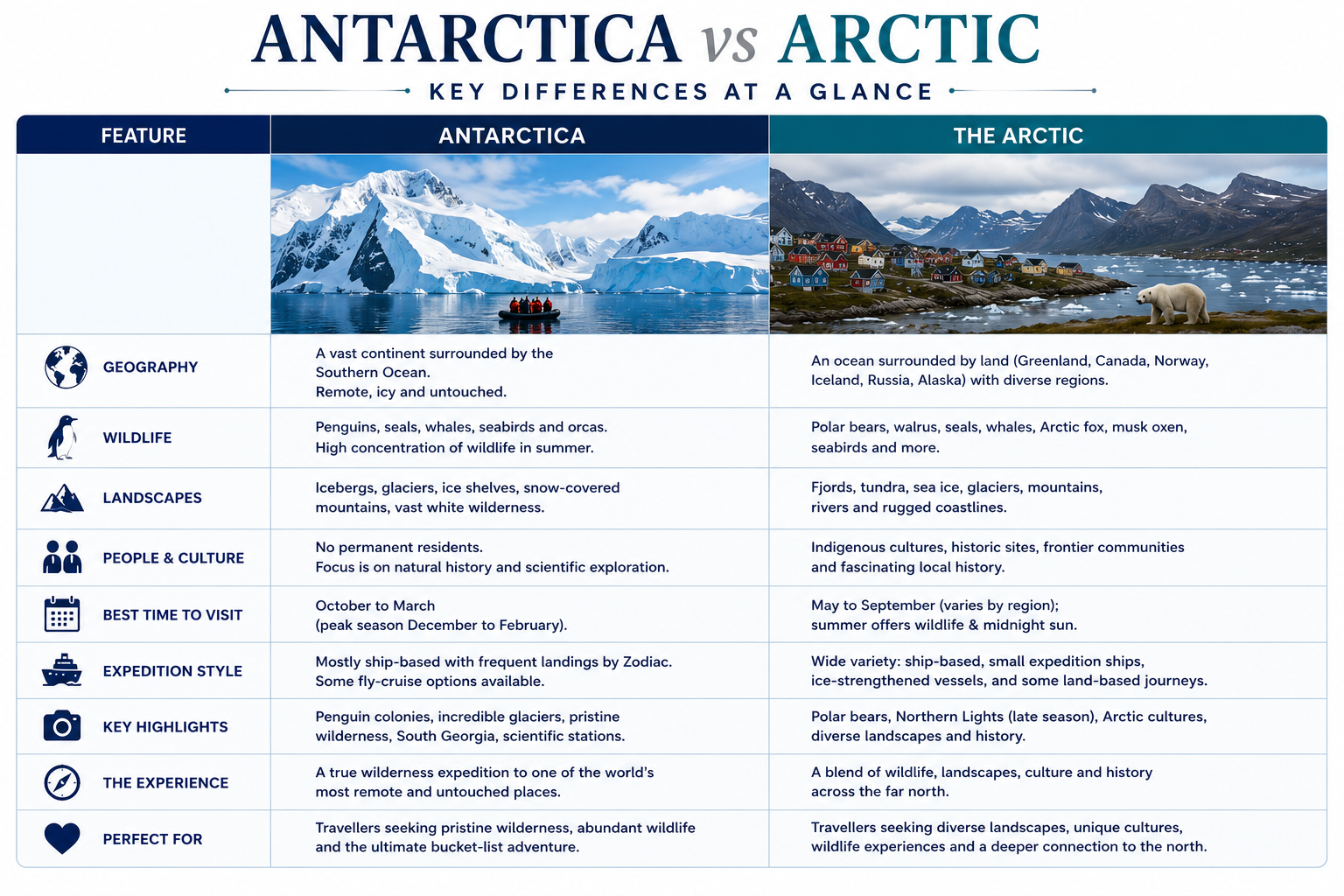
Although Antarctica and the Arctic are both polar regions, they offer remarkably different experiences.
Antarctica
Antarctica is often described as the last great wilderness.
Travellers come here for enormous icebergs, spectacular glaciers, vast penguin colonies, seals resting on drifting ice and incredible whale encounters later in the season.
Most expeditions visit the Antarctic Peninsula, while longer itineraries may include South Georgia, the Falkland Islands, the Weddell Sea or the Ross Sea.
If you’re looking for dramatic landscapes and abundant wildlife in one of the world’s most remote environments, Antarctica is difficult to match.
The Arctic
The Arctic offers something entirely different.
Instead of one continent, it’s a collection of diverse regions including Greenland, Svalbard, Iceland, the Canadian Arctic and the Northwest Passage.
Here you’ll discover colourful Arctic communities, dramatic fjords, polar bears, walrus, musk oxen and fascinating Indigenous cultures.
Each Arctic destination has its own personality, making itinerary selection particularly important.
2. Decide When You’d Like to Travel
Timing plays a significant role in shaping your expedition.
Antarctica
Early Season (October–November)
- Fresh snow
- Spectacular ice formations
- Penguin courtship and nesting
- Fewer visitors
Mid Season (December–January)
- Long daylight hours
- Penguin chicks begin to hatch
- Excellent Zodiac cruising
- Peak expedition season
Late Season (February–March)
- Outstanding whale sightings
- Active seal colonies
- Beautiful golden Antarctic light
- Less sea ice in many areas
Arctic
Depending on your destination and travel dates, you may experience:
- Midnight sun
- Polar bears
- Walrus haul-outs
- Migratory birds
- Colourful tundra
- Autumn colours
- Northern Lights (on selected late-season itineraries)
If wildlife is your priority, choosing the right month can make all the difference.
3. Choose the Right Itinerary
Once you’ve decided whether Antarctica or the Arctic is calling you, the next question is where within that region you actually want to explore.
This is an important distinction because choosing “Antarctica” or “the Arctic” is only the beginning. Each region offers multiple expedition routes, and the itinerary you choose determines much of what you’ll see and experience.
Two polar expeditions can take place during the same month and still offer remarkably different journeys.
Choosing an Antarctica Itinerary
For first-time visitors, the Antarctic Peninsula is often the natural starting point. It offers the classic Antarctic experience: dramatic ice-covered landscapes, penguin colonies, seals, whales, Zodiac cruising and opportunities to step ashore on the Antarctic continent.
But it’s far from the only option.
Travellers with more time may consider an expedition combining the Antarctic Peninsula, South Georgia and the Falkland Islands. South Georgia is particularly renowned for its extraordinary concentrations of wildlife, including vast king penguin colonies, while the Falklands add a very different landscape, history and range of birdlife.
More specialised expeditions may venture into the Weddell Sea, where immense tabular icebergs and remote landscapes create a very different Antarctic experience. Some itineraries venture towards Snow Hill Island, an area associated with one of the world’s most remarkable emperor penguin colonies.
For travellers drawn to the history of polar exploration and exceptionally remote destinations, longer expeditions to the Ross Sea offer another possibility.
There are also different ways of reaching Antarctica. Traditional voyages sail across the Drake Passage from South America, while fly-cruise itineraries allow travellers to fly across the Drake in one or both directions.
So even within Antarctica, there isn’t one standard expedition.
Choosing an Arctic Itinerary
The Arctic requires just as much thought, perhaps even more.
Unlike Antarctica, which is a continent surrounded by ocean, the Arctic spans an enormous area across several countries. An expedition to Svalbard can be completely different from travelling through Greenland, the Canadian Arctic or the Northwest Passage.
Svalbard is one of the Arctic’s best-known expedition destinations. Its combination of glaciers, mountains, tundra and sea ice makes it particularly appealing to wildlife enthusiasts, with opportunities to search for polar bears, walrus, Arctic foxes, reindeer, seals and abundant birdlife.
Greenland offers another kind of Arctic journey. Here, enormous fjords and glaciers are combined with colourful settlements and opportunities to learn about Greenlandic culture and life in the far north. Depending on the itinerary, travellers may explore areas along the west, south or remote east coast, each offering a distinctly different experience.
Expeditions through the Canadian Arctic combine wildlife, history, remote landscapes and connections with Inuit communities. Some itineraries explore areas such as Baffin Island and Lancaster Sound, while longer journeys may attempt sections or crossings of the legendary Northwest Passage.
Other Arctic expeditions may incorporate Iceland, northern Norway or journeys towards the High Arctic, creating still more possibilities.
This means that asking “Should I visit the Arctic?” is really only the first question.
The next should be:
“Which Arctic experience am I looking for?”
Start With the Experience, Not the Departure Date
Before comparing available departures, think about what you’d most like your expedition to include.
If enormous penguin colonies are high on your list, an Antarctica itinerary incorporating South Georgia may deserve consideration.
If searching for polar bears is a priority, certain High Arctic itineraries may be more appropriate.
If you’re fascinated by human history and culture, Greenland, the Canadian Arctic and the Northwest Passage can offer experiences that simply don’t exist in Antarctica.
And if glaciers, icebergs and spectacular polar scenery are what first drew you north or south, you’ll have choices in both regions.
Consider asking yourself:
- Which wildlife am I most hoping to encounter?
- Are dramatic landscapes my priority?
- Do I want cultural experiences as part of my expedition?
- Am I interested in polar exploration history?
- How many days can I realistically travel?
- Do I want a classic introductory expedition or somewhere more remote?
- Are there particular activities I’d like to include?
- Would I prefer several destinations within one longer itinerary or a more focused exploration of one region?
These questions can quickly narrow what initially seems like an overwhelming number of options.
4. Choose the Right Expedition Ship
Once you’ve narrowed down where you want to go, the next decision is an important one: which ship will take you there?
On a polar expedition, your ship is much more than your accommodation. It is your base for exploration, your transport between remote locations, your wildlife-viewing platform and the place you’ll return to after each day’s adventures.
There is no single “best” expedition ship. The right choice depends on where you’re travelling, how you want to explore and what level of comfort and activity you’re looking for.
Start With Ship Size
Passenger numbers can have a noticeable impact on the style and pace of an expedition.
Smaller expedition vessels can offer an intimate atmosphere and may provide greater flexibility when navigating remote areas. Larger expedition ships, meanwhile, can offer more spacious cabins, multiple restaurants, larger wellness facilities and a broader range of onboard amenities.
In Antarctica, passenger numbers have another practical consideration. Under Antarctic tourism guidelines, vessels carrying more than 500 passengers are cruise-only and cannot make passenger landings. Expedition vessels carrying up to 500 passengers can make landings, although no more than 100 passengers may be ashore at a landing site at one time.
That doesn’t automatically make one ship size better than another. It simply means you should understand how a vessel’s passenger capacity may affect the way shore activities are organised.
In the Arctic, operations are different and vary considerably between destinations. An expedition around Svalbard, for example, has different logistical considerations from a voyage through Greenland or the Northwest Passage. Responsible Arctic expedition operations must also account for fragile environments, local cultures, historical sites and the particular safety challenges of travelling in remote northern waters.
Look at What the Ship Is Designed to Do
A beautiful cabin is important, but don’t judge an expedition ship by its accommodation alone.
Ask what the vessel is actually capable of doing in the destination you’re visiting.
Different ships may offer features such as:
- Fleets of Zodiac boats for landings and coastal exploration
- Kayaking programmes
- Dedicated photography facilities
- Science and citizen-science programmes
- Helicopter operations on selected ships and itineraries
- Observation lounges and extensive outdoor viewing decks
- Specialist equipment for particular Arctic or Antarctic routes
The importance of each feature depends entirely on what you want from your journey.
Someone interested primarily in wildlife photography may place greater value on excellent observation areas and easy access to outdoor decks. An adventurous traveller might prioritise kayaking or other off-ship activities. Someone travelling primarily for scenery may prefer a ship with generous viewing spaces.
The question isn’t “Which ship has the most features?”
It’s “Which features will actually improve the expedition I want to have?”
5. Think About the Wildlife and Experiences You Want
For many travellers, wildlife is one of the biggest reasons for travelling to the polar regions. But saying you want to “see wildlife” isn’t quite enough when choosing an expedition.
The wildlife of Antarctica and the Arctic is highly seasonal, and the experiences available can change depending on where you travel, when you travel and the itinerary you choose.
Before choosing your departure date, think about the moments you’re most hoping to experience.
Is it watching penguin chicks in Antarctica? Searching for polar bears among Arctic sea ice? Seeing whales feeding around the Antarctic Peninsula? Photographing walrus in Svalbard? Kayaking among icebergs? Or experiencing the long days of the polar summer?
Once you know what matters most, you can begin matching your priorities to the right region and season.
Wildlife in Antarctica: The Season Changes the Experience
The Antarctic expedition season generally runs through the austral summer, from around October/November to March. But Antarctica doesn’t look or behave exactly the same throughout those months.
Early Season: October to November
Early in the season, Antarctica emerges from winter.
Snow and ice conditions can be particularly striking, while penguin colonies become increasingly active with courtship, nest building and egg laying. Depending on the itinerary, this can also be an interesting period for breeding activity among seals and seabirds.
For travellers particularly interested in dramatic ice, snowy landscapes and the beginning of the breeding season, early departures can be very rewarding.
Mid-Season: December to January
December and January bring exceptionally long daylight hours and increasing activity at penguin colonies.
Depending on species and location, eggs begin hatching and colonies become increasingly busy with chicks. This is one reason the middle of the Antarctic summer is particularly popular with wildlife enthusiasts and photographers.
Whale numbers also build as the summer progresses, while long daylight hours provide plenty of opportunity for exploration.
Late Season: February to March
Later in the season, the wildlife story changes again.
Penguin chicks are growing and beginning to fledge, while whale activity becomes a major attraction. Humpback and other whales migrate south to feed during the productive Antarctic summer, making February and into March particularly appealing for travellers who place whale encounters high on their wish list.
As sea ice retreats in some areas, changing conditions may also influence where expedition vessels are able to explore.
There isn’t necessarily a single “best month” to visit Antarctica.
There’s a better month for what you personally want to experience.
Wildlife in the Arctic: Location Matters Just as Much as Timing
Planning around wildlife in the Arctic is somewhat different.
The Arctic covers an enormous geographic area, so wildlife opportunities depend heavily on the destination and itinerary.
A voyage around Svalbard isn’t the same wildlife experience as an expedition along Greenland’s coast or through the Canadian Arctic.
Polar Bears
For many travellers, seeing a polar bear in the wild is one of the great attractions of an Arctic expedition.
Polar bears occur across wide areas of the Arctic and are strongly associated with sea-ice environments, where they spend much of their lives and hunt primarily for seals.
Svalbard and parts of the Canadian and Greenlandic Arctic can offer opportunities to search for them, but sightings should never be treated as guaranteed.
That’s part of true expedition travel: wildlife is wild.
Finding it depends on location, ice, weather, animal movements and the experience of the expedition team.
Walrus, Whales and Arctic Mammals
Polar bears may receive much of the attention, but Arctic wildlife extends far beyond them.
Depending on your destination, you may encounter walrus, whales, seals, Arctic foxes, reindeer or musk oxen.
Walrus, for example, occur across the circumpolar Arctic, including populations around East Greenland and Svalbard.
Different Arctic regions support different species, which is another reason to look closely at the itinerary rather than choosing an expedition based only on the words “Arctic cruise.”
Seabirds and the Arctic Summer
Summer also brings extraordinary birdlife to parts of the Arctic.
Cliffs and coastal areas can become important breeding grounds for large numbers of seabirds, while the long hours of daylight give expedition teams considerable opportunity to explore when conditions permit.
Again, the experience changes according to where you travel. Svalbard, Greenland, Iceland and the Canadian Arctic each offer their own combination of wildlife, landscapes and seasonal activity.
Don’t Forget the Experiences Beyond Wildlife
Wildlife may be one of the highlights, but it isn’t the only reason to think carefully about when and where you travel.
Polar expeditions can offer experiences such as:
- Zodiac cruising among icebergs and along remote coastlines
- Kayaking in polar waters
- Photography programmes and workshops
- Hiking and walks ashore
- Camping on selected Antarctic expeditions
- Snowshoeing on selected voyages
- Citizen-science activities
- Helicopter flightseeing on selected ships and itineraries
- Visits to research stations or historic sites where permitted
- Visits to Arctic communities on appropriate itineraries
Not every activity is available on every ship or departure. Some are included in the expedition fare, some require advance registration, and others may carry an additional cost.
If there’s something you particularly want to do, make it part of your planning from the beginning rather than discovering after booking that your chosen voyage doesn’t offer it.
What About the Northern Lights?
This is another area where timing matters.
Travellers sometimes associate every Arctic expedition with the Northern Lights, but the midnight sun and the aurora don’t go hand in hand.
During the height of the Arctic summer, some regions experience extremely long daylight or 24-hour sunlight. That makes the sky too bright for meaningful aurora viewing.
If seeing the Northern Lights is an important part of your journey, you’ll need to look at itineraries operating when sufficient darkness has returned and in destinations where aurora viewing is realistic.
It may mean choosing a different time of year from someone whose priority is wildlife or the midnight sun.
Build Your Expedition Around Your Priorities
Before you book, try making a short list.
Ask yourself:
What are the three things I would be most disappointed to miss?
Perhaps they’re:
- Penguin chicks
- Whales
- Polar bears
- Walrus
- South Georgia’s wildlife colonies
- Arctic birdlife
- Kayaking
- Photography
- Northern Lights
- Midnight sun
- Cultural experiences
- Dramatic sea ice and glaciers
Your answers can tell you a surprising amount about which destination, itinerary and time of year will suit you best.
And remember: no responsible expedition specialist can promise a particular wildlife sighting.
Weather changes. Ice moves. Wildlife moves. Landing sites may change.
That unpredictability isn’t a flaw in expedition travel, it’s part of what makes it an expedition.
The goal is therefore not to find a departure that promises everything. It’s to choose a region, season and itinerary that give you the best opportunity to experience the things that matter most to you.
6. Think About How You’ll Get There
One of the less obvious parts of planning a polar expedition is getting to the point where the expedition actually begins.
Unlike a conventional cruise departing from a major international port, reaching Antarctica or the Arctic can involve international flights, domestic connections, overnight stays and travel to relatively remote gateway cities.
Your expedition may last ten days, for example, but your complete journey could require several additional days before and after the voyage.
Understanding these logistics early can help you choose an itinerary that works not only for your interests, but also for the time you have available.
Getting to Antarctica
Most Antarctic Peninsula expeditions begin in southern South America, with Ushuaia, Argentina, being the most familiar departure point for voyages sailing across the Drake Passage.
Other expedition programmes may involve travel through Punta Arenas in Chile, particularly for fly-cruise itineraries.
For travellers coming from Australia, North America, Europe or elsewhere, this means the journey to Antarctica starts well before you see your first iceberg.
You’ll need to consider international connections, domestic or regional flights, accommodation before embarkation and enough contingency time to protect against delays.
This is one reason we generally recommend avoiding tight flight connections immediately before an expedition.
Missing a conventional cruise departure is inconvenient.
Missing an expedition vessel heading towards Antarctica can be considerably more complicated.
Fly the Drake or Sail the Drake?
For Antarctic Peninsula travellers, one of the biggest logistical decisions may be whether to sail across the Drake Passage or fly over it.
Sailing the Drake
The traditional route involves departing southern South America by expedition ship and crossing the Drake Passage before reaching the Antarctic Peninsula.
For many travellers, the crossing is part of the expedition itself.
Those sea days allow time to settle into life aboard, meet the expedition team, attend presentations and watch for seabirds and marine wildlife as the ship travels south.
There is also something special about approaching Antarctica by sea and gradually watching the environment change around you.
The obvious consideration is the Drake’s reputation for unpredictable conditions.
Some crossings can be relatively calm; others can be considerably rougher. No one can reliably predict exactly what conditions you’ll experience when you travel.
Flying the Drake
Fly-cruise expeditions provide an alternative.
Rather than sailing the entire Drake Passage, travellers fly between southern Chile and King George Island in the South Shetland Islands, where they join or leave their expedition vessel.
This can significantly reduce the amount of time spent at sea and makes shorter Antarctic itineraries possible.
It may appeal particularly to travellers who:
- Have limited holiday time
- Are concerned about seasickness
- Prefer to maximise their time around Antarctica
- Don’t consider the Drake crossing an essential part of their experience
However, flying doesn’t remove weather from the equation.
Flights to and from Antarctica operate in an environment where conditions can change quickly. Delays are possible, which is why fly-cruise programmes have specific contingency arrangements that travellers should understand before booking.
Neither option is inherently better.
For some people, crossing the Drake is part of the story.
For others, flying makes Antarctica possible within the time they have available.
The right choice is the one that works for you.
Getting to the Arctic
The Arctic presents a very different logistical picture because there isn’t one primary gateway.
Where you begin depends entirely on which part of the Arctic you’re exploring.
An expedition to Svalbard, for example, will typically involve reaching Longyearbyen, while Greenland expeditions may begin or end in Greenland itself or use another northern gateway depending on the itinerary.
Canadian Arctic and Northwest Passage expeditions can involve charter flights and remote embarkation or disembarkation points, while other Arctic programmes may operate from ports in Iceland or northern Norway.
This means two Arctic expeditions of the same length can require very different travel arrangements.
When comparing itineraries, don’t look only at Day 1 on the brochure.
Find out how you actually get to Day 1.
7. Plan for the Full Cost of Your Polar Expedition
When budgeting for Antarctica or the Arctic, it’s important to look beyond the advertised expedition fare. The cost of your voyage will usually be the largest expense, but it may not represent the complete cost of your journey.
Your overall budget may also need to account for international and regional flights, charter flights, pre- and post-expedition accommodation, travel insurance, optional activities, transfers, gratuities and personal spending.
Just as importantly, compare what’s included in the expedition fare. Two voyages with similar prices can offer very different inclusions. One may include charter flights, hotel accommodation, transfers, expedition clothing or selected activities, while another may charge for these separately.
Cabin choice can also significantly affect your budget. Options can range from shared and solo accommodation to balcony cabins and larger suites. Solo travellers should pay particular attention to dedicated solo cabins, cabin-sharing options and single supplements, as these vary between ships and operators.
If activities such as kayaking, camping, helicopter experiences or specialised photography programmes are important to you, check whether they’re included, available at an additional cost or need to be reserved in advance.
Promotional offers can provide excellent value, particularly when planning early, but a discount shouldn’t determine which expedition you choose. First consider whether the itinerary, ship, departure date and experience are right for you, and then assess the offer.
Ultimately, price and value aren’t the same thing. The lowest advertised fare isn’t necessarily the least expensive journey once all the additional costs are considered, and the most expensive expedition isn’t automatically the best.
This Is Where We Can Help
With so many combinations of destinations, ships, cabins, inclusions and prices available, comparing polar expeditions can quickly become overwhelming.
At North South Voyages, we take the time to understand what you’re looking for, your interests, preferred travel dates, the experiences that matter most to you and, importantly, the budget you’d like to work within.
From there, we research and build a selection of personalised quotes and itinerary options for you to consider, rather than simply presenting you with one expedition and expecting you to make it fit.
This allows you to compare different possibilities and understand what you’re getting for your budget before deciding which journey feels right for you.
When comparing your options, remember to look at the complete picture:
Expedition fare + travel arrangements + accommodation + activities + insurance + additional expenses = the real cost of your polar journey.
Starting your planning early gives you time to understand these costs, explore different possibilities and build a realistic budget for the experience you actually want.
And you don’t need to have all the answers before speaking with us, helping you work through those options is part of what we do.
8. Bring It All Together Before You Book
By the time you’re ready to compare expeditions, you should have a clearer idea of the kind of polar journey you’re looking for.
Think about your priorities as a whole: where you want to go, when you can travel, what you’d most like to experience, the style of ship and expedition you prefer, and the budget you’re comfortable with.
You don’t need to find an expedition that ticks every possible box. Instead, focus on the things that matter most to you and use those priorities to narrow down your options.
And remember that polar travel requires some flexibility. Weather, wildlife, sea ice and local conditions can influence what happens from day to day. That’s part of expedition travel and one of the reasons no two journeys are exactly alike.
9. So, When Should You Start Planning?
For most travellers, starting around 12–18 months before your intended departure is a good rule of thumb. It gives you time to research the different regions, compare itineraries and ships, consider your budget and choose from a wider range of departure dates and cabin categories.
If you have something very specific in mind, a particular itinerary, wildlife experience, ship, cabin category or limited travel dates, starting even earlier can be worthwhile.
But what if you’re already inside that 12-month window?
Don’t assume you’ve left it too late. Availability changes, new offers appear and suitable cabins may still be available. It’s always worth exploring your options rather than ruling out a polar expedition simply because you haven’t planned years ahead.
The most important thing is to start researching before you’re ready to make the final booking decision. Understanding what Antarctica and the Arctic have to offer will make it much easier to recognise the right expedition when you find it.
Continue Your Polar Journey
This guide is just the beginning.
Our Learning Centre has been created to help travellers make confident, informed decisions before booking a polar expedition. Explore our growing collection of expert articles covering everything from choosing the right itinerary and expedition ship to understanding wildlife seasons, packing advice, Fly the Drake expeditions, and the differences between Antarctica and the Arctic.
The more you know before you book, the more rewarding your expedition is likely to be.
When you’re ready to take the next step, our team is here to help you compare your options and find the polar journey that’s right for you.